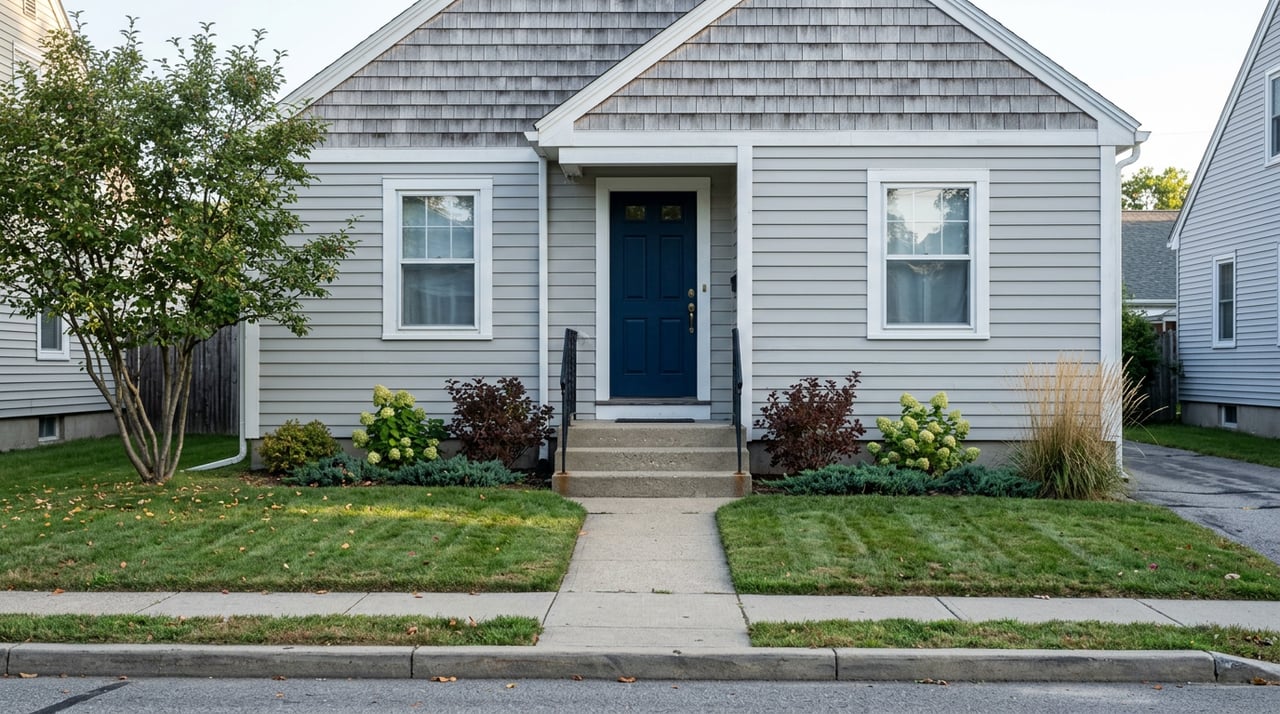
Search "median home price Two Harbors MN" on a slow afternoon and you can collect three answers before you finish your coffee. One data provider's April 2026 housing snapshot puts the citywide median home value at $187,100. A separate estimate built from the trailing twelve months of recorded sales lands at $284,405. Pull up an active MLS feed for Two Harbors captured on May 20, 2026, and the median list price across the dozen homes on the market that week was $499,000.
Those aren't typos and they aren't three different towns. They're three different slices of the same market, and once you understand why the slices stopped lining up, you'll read every other Two Harbors listing differently.
Three sources, three answers
Here's the spread, side by side:
| Source | What it measures | Snapshot | Figure |
|---|---|---|---|
| Citywide housing-value estimate | All owner-occupied housing stock | April 2026 | $187,100 |
| Trailing sales estimate | 184 recorded transactions, trailing 12 months | 2026 pull | $284,405 |
| Active MLS listings | 12 homes on market | May 20, 2026 | $499,000 median list |
A citywide estimate averages in every modest inland ranch and postwar bungalow that's never changed hands. A trailing-sales figure only counts what actually closed, which skews toward whatever happened to sell that year. An active-listings snapshot captures whatever a small handful of sellers chose to list that particular week, and in a town this size, a single lakefront property or a cluster of fixer-uppers can swing the median hard in either direction.
That's the ordinary reason medians disagree in any small market. Two Harbors has a second reason, and it's the one nobody puts in the listing description.
The rule that splits the housing stock in two
In May 2022, the city amended its short-term rental code through Ordinance No. 126, updating Section 4.42 of the Two Harbors City Code. The amendment did two things that matter enormously if you're comparing homes here.
First, the city stopped issuing new short-term rental permits in residential zoning districts. Anyone who wants a new STR permit today has to buy in a B1 or B2 commercial zone instead, according to the STR compliance platform strprofitmap.com, which tracks municipal rental ordinances across the state.
Second, and this is the part that catches buyers off guard: existing permits in residential zones are non-transferable. The permit is tied to the person who held it when the ordinance passed, not to the house itself. Sell the property, and the permit terminates automatically. The new owner cannot renew it, inherit it, or reapply for it in that zoning district. Permits also expire every December 31 and must be renewed by November 1 of each year, so even a current holder has an annual paperwork deadline standing between them and next season's bookings.
Put plainly:
A short-term rental permit in a Two Harbors residential neighborhood dies the moment the deed changes hands. Whatever income that permit generated for the seller does not come with the house.
That single rule is what quietly split the town's housing stock into two permanently different categories: a shrinking pool of homes still allowed to earn short-term rental income, and everything else, which can't legally replicate that revenue unless the buyer is purchasing commercial-zoned property instead.
What "income potential" actually means on a listing
Two Harbors draws overnight visitors for real reasons. Split Rock Lighthouse State Park sits just up the shore. The Two Harbors Lighthouse, Minnesota's oldest operating lighthouse, anchors the harbor itself. Gooseberry Falls and the Superior Hiking Trail pull hikers through town most of the year, and Agate Bay and Burlington Bay give the waterfront its draw for anyone who wants to fall asleep to the sound of Lake Superior.
That demand shows up in the revenue numbers. In its 2026 market data, strprofitmap.com estimates Two Harbors hosts earn a median $47,650 per year at a $279 average daily rate and 63 percent occupancy. A separate analytics platform, AirROI, put median host earnings at $33,560 over the trailing twelve months from July 2025 through June 2026, at a $253 nightly rate and 44.1 percent occupancy, with total STR supply growing 63.6 percent over that same window.
Those two numbers don't match each other, which is a useful reminder on its own that STR revenue estimates vary widely by methodology and sample. But the number that should stop you before you write an offer is neither of them. It's the permit status of the specific house you're looking at.
A listing that leans on "vacation rental income" or "proven rental history" is describing what the current owner earned under a permit that, in a residential zone, cannot follow the sale. If the property sits outside a B1 or B2 commercial district, you would be buying the house without the ability to legally operate it as a short-term rental at all, regardless of what the seller's booking calendar looked like last summer.
If you already hold a permit and you're thinking about selling
This cuts the other way too, and it matters if you're the one holding a residential STR permit and weighing a sale. Because the permit can't transfer, any marketing built around your rental income needs to be framed as historical performance under a permit the buyer won't inherit, not as a feature of the property itself. Overstating it invites a disclosure problem you don't want during a closing. Being direct about it, on the other hand, is exactly the kind of thing that keeps a buyer's agent from renegotiating the price after the fact.
Before you write an offer on a "vacation rental income" listing
- Confirm the zoning district directly, not from the listing description. B1 and B2 commercial parcels are the only ones eligible for new STR permits.
- If the home is in a residential zone, ask the listing agent whether the current STR permit is active and call the city clerk's office to verify it independently. An active permit today tells you nothing about what you'll be allowed to do after closing.
- Treat any quoted rental income as the seller's history, not a transferable asset. Underwrite the purchase on the home's value as a residence first.
- If short-term rental income is the whole reason you're buying, shift your search to commercial-zoned inventory where new permits are still possible, and confirm current permit-issuance status with the city before assuming availability.
- Ask what other listings in the same price range sold for as owner-occupied homes versus permitted rentals over the past year. That gap is often the clearest read on how much of the asking price is really the permit.
So what does the median home price actually tell you
Go back to that spread. The $187,100 citywide figure is dominated by ordinary owner-occupied homes, the kind that were never eligible for a rental permit and never will be under the current rule. The $284,405 trailing-sales estimate blends in whatever mix of permitted and non-permitted homes happened to close that year. The $499,000 active-listing median reflects whichever handful of sellers chose to list that particular week, and lakefront or STR-adjacent properties tend to sit at the top of that range longer, which pulls an active-listing median higher than a closed-sales median almost by definition.
None of those numbers is wrong. They're measuring different things, and the zoning line running through the middle of Two Harbors' housing stock is a big part of why those different things no longer resemble each other the way they might have a decade ago. The next time you see a median price quoted for this town, the useful question isn't whether the number is accurate. It's which slice of inventory it's actually counting, and whether that slice includes a permit you won't be able to keep.
FAQ
Can I apply for a short-term rental permit on any home I buy in Two Harbors? Only if the property sits in a B1 or B2 commercial zoning district. New permits in residential zones are not being issued under the current ordinance.
What happens to an existing STR permit if I inherit or am gifted the property? The code treats heirs and transferees the same as any other new owner in a residential district. The permit does not carry over, and a new application in that zone will be denied.
If you're weighing a move to Two Harbors, or trying to figure out what a specific listing's rental history actually means for your offer, Michelle Ryan has spent years reading these listings the way locals do, not the way a national portal's algorithm does. Reach out for a straight conversation about what you're looking at before you write anything down.
This article is general information, not legal, tax or financial advice. Consult a qualified professional about your situation.